


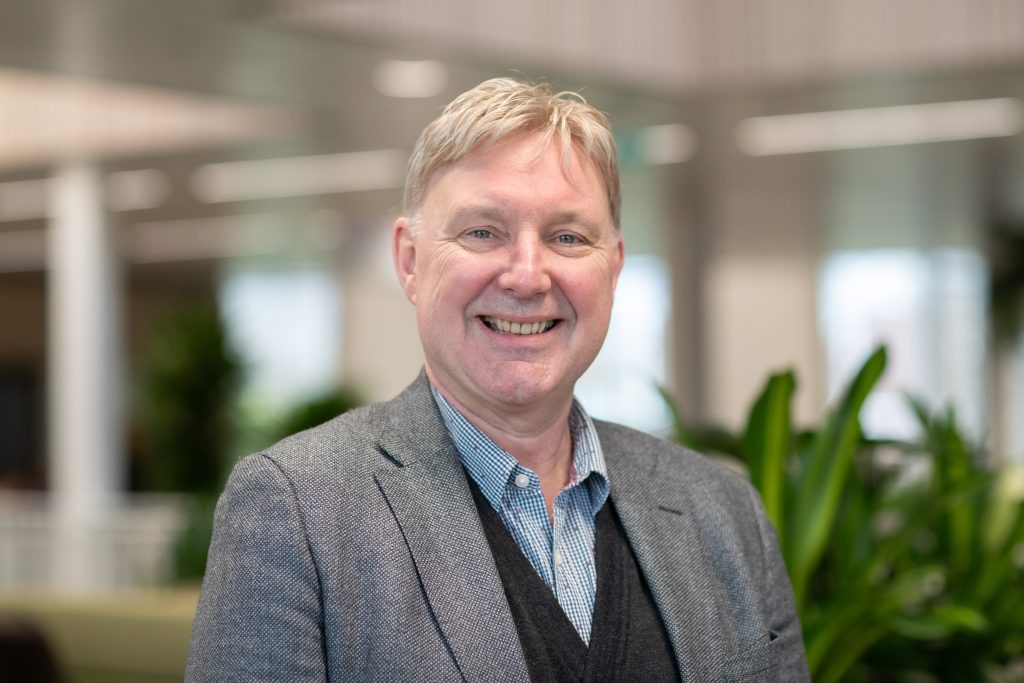
Eric Coorens has been appointed in January this year as associate lecturer ‘Transitions through Collective Strength’ at the New Entrepreneurship research group.As an associate lecturer, Eric focuses on the question of how organizations, supply chains, and regions can move faster together in complex transition challenges, such as the energy transition, biobased construction, and labor market transitions. His focus is on strengthening collective capacity for change, so that transitions do not stall due to fragmentation or short-term interests.
Transitions through Collective Strength: Research on What Makes Collaboration Work for a Wellbeing Economy
The associate research group Transitions through Collective Strength, part of the CoE Wellbeing Economy and New Entrepreneurship (BWNO), investigates how organizations, supply chains, and regions can move forward more quickly together in large-scale transition challenges. These challenges include the energy transition, biobased construction, and labor market transformations. In practice, such initiatives often stall due to fragmentation, conflicting interests, short-term incentives, and a lack of implementation capacity.
We focus on a simple core question: what helps parties make collective decisions and actually do what is needed, even when interests differ and the context is complex? To answer this, we explicitly bring together four perspectives:
-
Technical: what works in the solution itself
-
Economic: what are the incentives, costs, and benefits
-
Socio-organizational: how people collaborate and coordinate
-
Ecological: what this means for environmental limits and goals
We examine these challenges at multiple levels simultaneously, while remaining practical. We explore what people and teams need to act, what organizations need to decide and organize, what supply chains and networks need to uphold agreements, and what regions and territories need to maintain pace and direction. At the same time, we keep the larger transition challenge in view: what counts as “progress” when the ultimate goal is a wellbeing economy?
Core Research Focus and Questions
The associate research group develops and tests interventions that improve collaboration and implementation in multi-actor challenges. Our approach is rooted in business and transition management, focusing less on individual behavior and more on organizing, decision-making, risk and benefit allocation, and learning through practice.
Specifically, we investigate:
-
Which agreements and rules make collaboration effective in practice (who decides what, when, and with which mandates)?
-
Which combination of technical choices, financial incentives, and organizational forms drives progress without cost-shifting?
-
How can risks, investments, and benefits be allocated so that all parties remain engaged?
-
How can practical experiences be turned into reusable “ways of working” for similar situations, so that each transition does not have to start from scratch?
Methodology: Practice-Oriented and Co-Creative
We work in a practice-oriented and co-creative way with entrepreneurs, public organizations, societal partners, and students. This happens within development networks and living labs, using multiple case studies simultaneously. Our work combines three approaches:
-
Mapping what happens – documenting case histories and decision moments
-
Testing interventions in practice – for example, decision-making formats, governance agreements, and learning/evaluation routines
-
Comparing cases – understanding what is context-dependent and what is transferable
Intended Outcomes: Value for Practice, Regions, and Education
For Practice Partners (Companies, Governments, Societal Organizations)
-
Concrete frameworks and tools for decision-making and collaboration in transitions
-
Improved implementation: clear roles, agreements, rhythms, and evaluations that hold up under pressure
-
Actionable knowledge that can be applied directly in projects related to energy, biobased construction, and labor market transitions
For Regions and Supply Chains:
-
Insights into what accelerates or blocks regional collaboration, and how to organize it without “consultation for consultation’s sake”
-
Approaches to make choices about pace, direction, and allocation explicit and discussable
For Education and New Generations of Professionals
-
Up-to-date case studies, assignments, and methodological building blocks to teach students how to work with real dilemmas and multiple perspectives
-
Co-creation with education: students actively contribute to projects and bring analysis and design skills back into practice